
Making Quality Western Hay: Cutting, Raking and Baling With Dew
Learn how quality western hay is cut, raked and baled with dew for horses, livestock, feed stores and wholesale buyers.
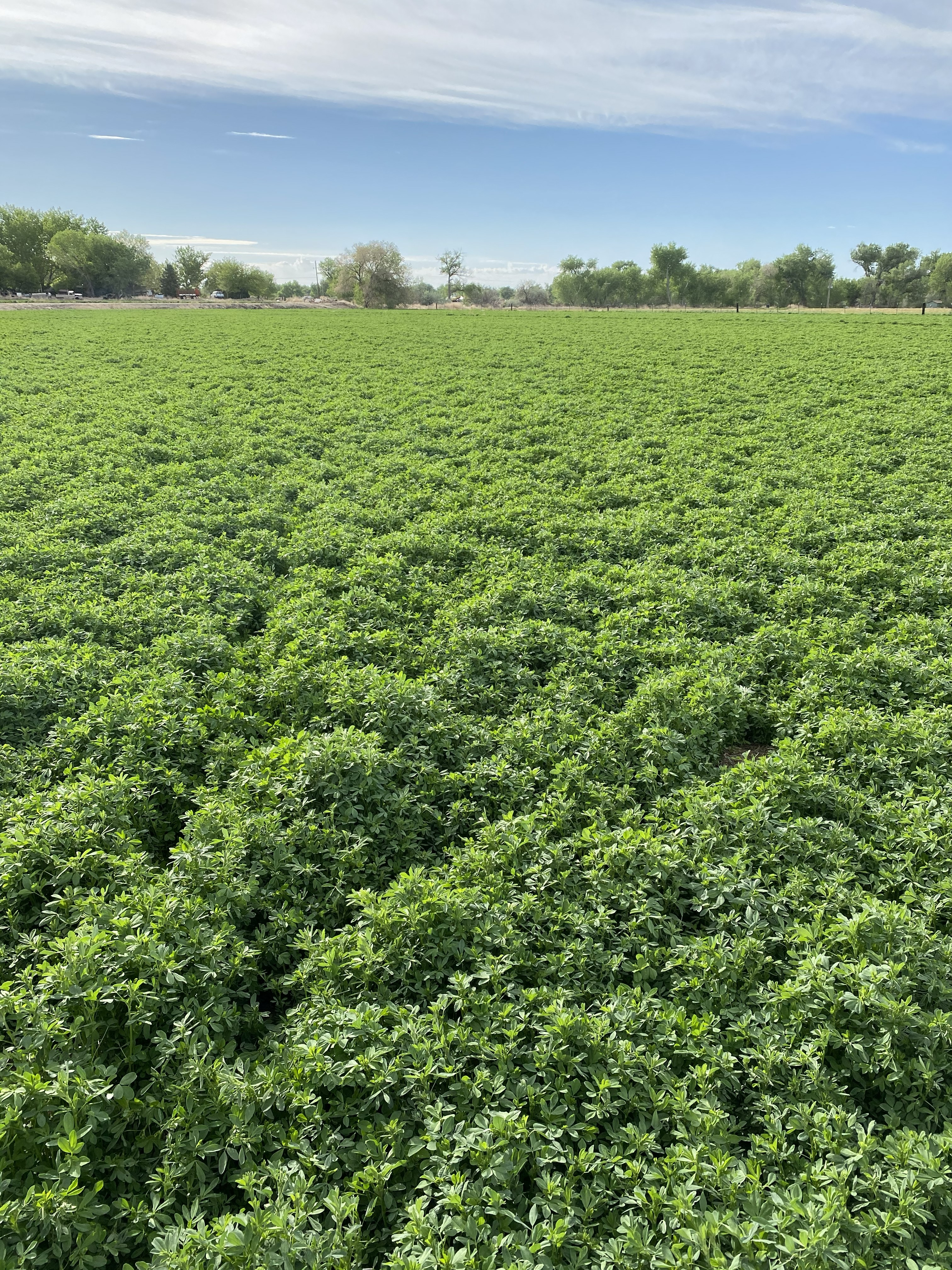
Good hay is not made by one pass through the field. It is the result of a series of decisions—when to cut, how to handle the crop while it dries, when to rake and whether conditions are right to bale.
At Fagundes Farms in Fallon, Nevada, our goal is to preserve as much of the crop’s natural quality as possible. That means protecting the leaves, keeping soil out of the windrow and putting hay into the bale at the right moisture.
Those details matter whether the finished western hay is going to horse owners, cattle producers, other livestock operations, feed stores or wholesale hay buyers.
Quality begins with the cut
The maturity of the crop at cutting has a major effect on the finished hay. Younger forage generally provides higher feed quality, while waiting longer can increase yield but also produce more stem and less-digestible fiber.
The best time to cut depends on the crop, its intended use, the condition of the stand and the weather ahead. Alfalfa, teff grass and wheat hay do not all mature or dry in exactly the same way. A suitable weather window also matters because even a well-timed cutting can lose quality if it sits through rain or requires excessive handling.
Cutting height and equipment setup are important too. A clean, properly conditioned swath dries more evenly. Cutting too low or allowing equipment to scrape the soil can introduce dirt and increase ash content in the finished hay.
The goal is not simply to put the most hay into a bale. It is to find the right balance among feed value, yield, field health and the needs of the customer.
Drying evenly protects hay quality
After cutting, the goal is to remove moisture efficiently without overdrying the leaves.
Alfalfa stems hold moisture longer than the leaves. By the time the stems are ready to bale, the leaves can become brittle—especially in the dry air of the West. That difference creates one of the biggest challenges in making quality western hay.
Hay must be dry enough to store safely, but excessive drying and handling can cause valuable leaves to break away before they reach the bale. Because the leaves carry a large share of alfalfa’s nutritional value, heavy leaf loss reduces both the quality and the total amount of usable hay.
A uniform swath, proper conditioning and steady airflow help the crop cure more evenly. Weather, humidity, wind, swath density and field conditions still determine how quickly that happens, so hay cannot be managed by the clock alone.
Rake while the hay is still pliable
Raking forms the windrow that the baler will pick up, but it can also cause significant leaf loss when the crop is too dry.
For alfalfa, raking at approximately 35% to 40% moisture can provide a useful balance. The crop is dry enough for raking to improve the curing process, while the leaves still contain enough moisture to remain flexible.
Raking at very high moisture can twist or rope the hay instead of turning it properly, which may slow drying. Waiting until the hay is nearly ready to bale can create the opposite problem: brittle leaves that shatter when the rake touches them.
The goal is to move the crop while it is supple enough to handle without leaving the best part of the plant on the ground.
We also try to move hay only as much as necessary. Every additional pass can knock off leaves, break stems or pull soil into the windrow. Proper rake height, sensible ground speed and a clean pickup all contribute to better finished hay.
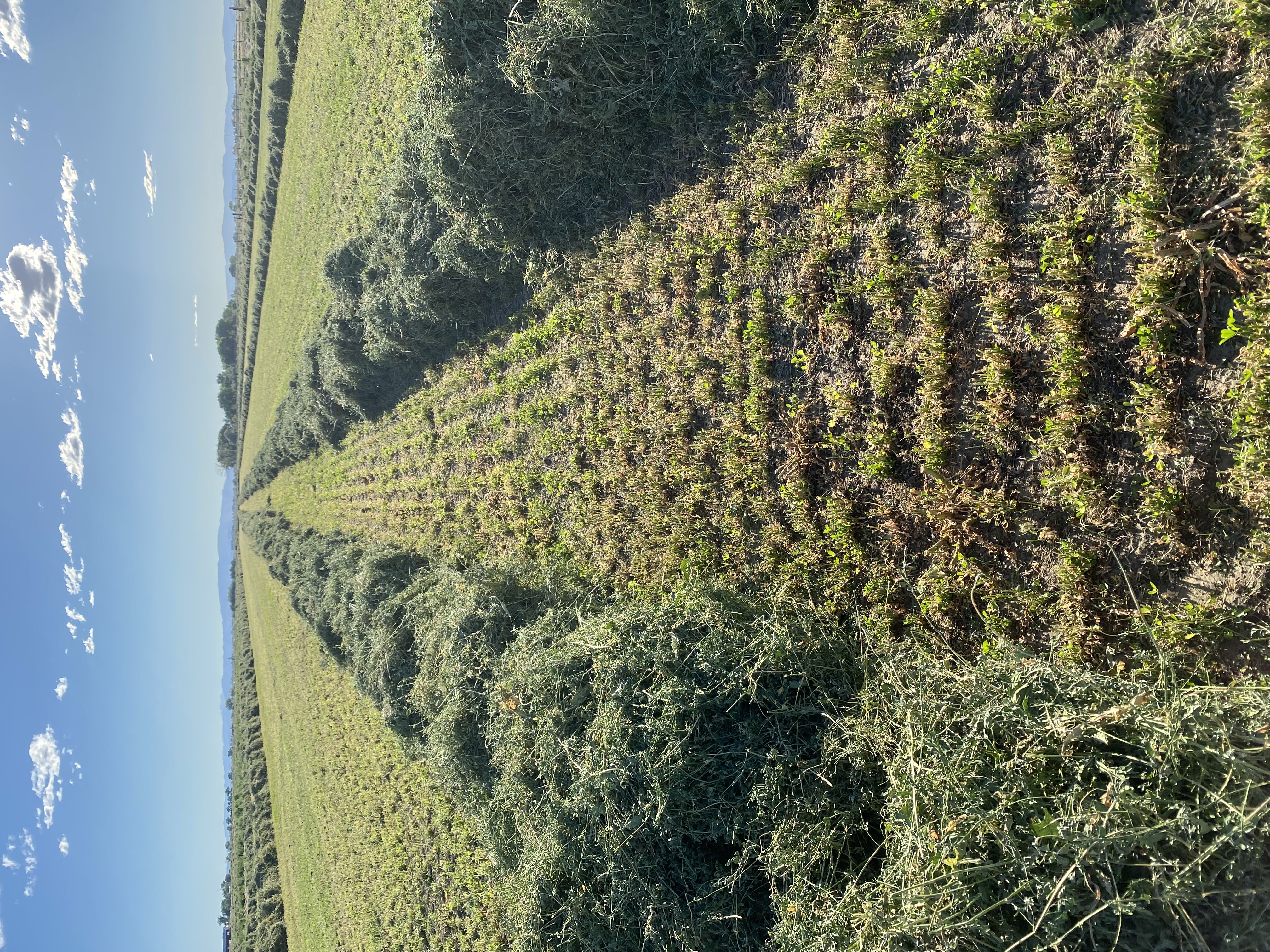
Well-formed windrows help hay cure consistently and feed smoothly into the baler.
Dew can be a tool, not a shortcut
“Baling with dew” does not mean baling hay before it has properly cured.
Once the hay is dry through the stem, light dew or higher relative humidity can soften dry leaves and reduce shatter as the crop passes through the baler. This can be especially valuable with alfalfa because retaining the leaves helps protect the quality of the finished bale.
Moisture from dew is found primarily on the outside of the leaves and stems. That is different from moisture that remains trapped inside an uncured stem. Surface moisture from dew can dissipate more readily, while internal stem moisture can remain trapped inside a dense bale.
The usable baling window can be narrow. Too little dew and the hay may remain brittle. Too much moisture—or moisture that is unevenly distributed through the windrow—can contribute to heating, discoloration, mold and storage problems.
That is why we evaluate the entire windrow rather than judging only the surface. We consider the feel of the hay, stem condition, changing weather and moisture readings from multiple locations.
Bale size changes the moisture decision
The correct baling moisture depends partly on bale size and density.
Small packages can release moisture more readily than large, dense bales. Common maximum-moisture guidance for alfalfa is below 20% for small two-tie bales, below 17% for larger three-tie bales and below 14% for one-ton bales.
These are maximum guidelines, not targets for every field or storage situation. Actual decisions must account for crop condition, moisture distribution, bale density, weather and storage conditions.
Large bales deserve particular care because moisture deep inside them dissipates slowly. Hay should not be baled above a safe moisture level with the expectation that it will finish drying in the stack.
Conditions are not always uniform across a field. A low area, a heavy windrow or the bottom of the windrow may retain more moisture than the rest of the crop. One reading from one convenient location does not necessarily represent the entire field.
A moisture meter helps confirm the decision
Experience is important, but guessing is not enough. A moisture meter provides another check before and during baling.
Readings should be taken from several locations and repeated as field conditions change. The numbers should be considered alongside the crop, bale size, bale density, stem condition and the uniformity of moisture throughout the windrow.
Newly baled hay should also be watched for unusual heating. Hay baled too wet can lose color and feed value, develop mold or, in severe cases, create a fire hazard.
Moisture testing does not replace experience. It gives the operator better information for making the final decision.
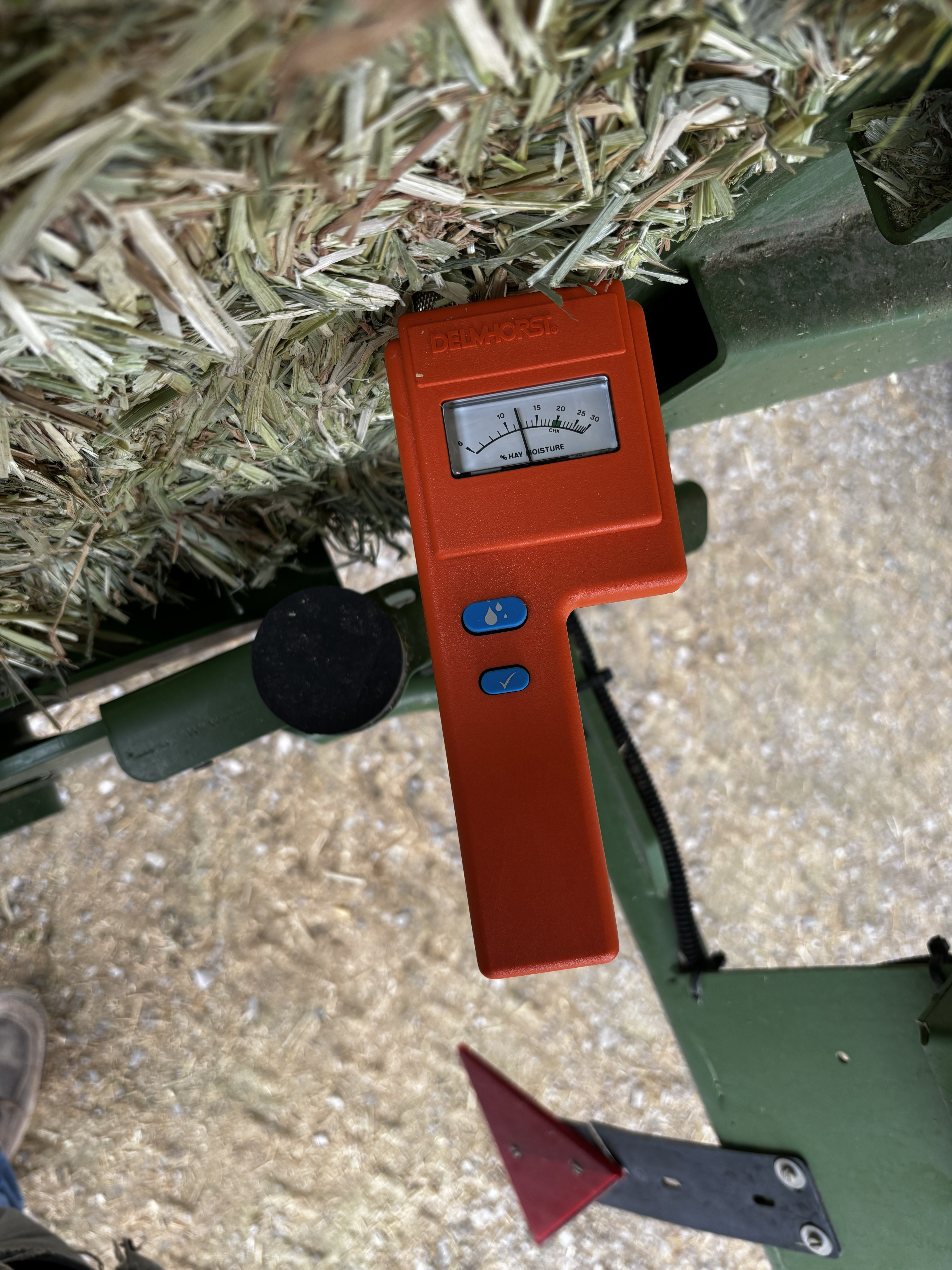
Readings from multiple locations help confirm when conditions are suitable for baling.
What hay buyers and feed stores should look for
Whether you are purchasing alfalfa hay for horses, western hay for cattle and other livestock, or wholesale hay for feed-store resale, it is important to evaluate the entire lot rather than judging one outside bale.
Useful quality indicators include:
- Good leaf retention for the crop and maturity
- A clean, fresh smell without mustiness
- No visible mold, excessive dust or foreign material
- Consistent bale size, density and condition
- Hay that is pliable rather than excessively brittle
- A representative forage analysis when specific nutritional values matter
Color can provide information about how hay was cured and stored, but appearance alone does not determine nutritional quality. When a horse, livestock ration or resale program requires specific feed values, a representative laboratory analysis provides better information.
Buyers should also consider how the hay will be handled, stored and transported. Bale size, total quantity and freight distance can be just as important as the type of hay when planning a purchase.
Quality is preserved one decision at a time
Hay does not become better after it is cut. From that point forward, every step is about protecting the quality already present in the plant.
Cut at the right stage. Give the crop a chance to cure evenly. Rake it while the leaves are pliable. Use dew carefully and only after the stems have properly cured. Measure moisture instead of relying on appearance alone. Adjust for bale size, then store the finished hay where it will remain dry and protected.
There is no single perfect hour that works for every field or every cutting. Quality western hay comes from paying attention to the crop and adjusting as conditions change.
That is the work behind every bale.